Consultant-Led, Non-Surgical Treatment in Alderley Edge, Cheshire
Dupuytren's contracture, sometimes called Viking disease, causes the tissue beneath the palm to thicken and tighten, gradually drawing one or more fingers in towards the hand. Low-dose radiotherapy is a non-surgical treatment that targets the active nodules and cords driving the condition. It is used in the earlier stages, before a fixed bend has developed, with the aim of slowing progression.
Ergéa Clinics specialises in low-dose radiotherapy for benign conditions like Dupuytren's. Treatment is delivered by consultant clinical oncologists at Alderley Edge Medical Centre on Talbot Road, around 25 minutes by train from Manchester Piccadilly. No referral required.
Understanding the Condition
Dupuytren’s contracture affects the fascia – the sheet of connective tissue beneath the skin of the palm. Small lumps called nodules usually form first. Over time, these can develop into cords that tighten and draw one or more fingers towards the palm, most often the ring or little finger. It is not usually painful, but it can gradually limit hand movement and make everyday tasks harder, such as gripping, writing, or laying your hand flat on a table. Stiffness and aching in the hand can also be caused by osteoarthritis, which we also treat with low-dose radiotherapy.
Dupuytren’s tends to progress in phases. Low-dose radiotherapy is used during the active phase, while nodules and cords are still forming and before a finger has developed a fixed bend. Once a contracture is established, radiotherapy is not expected to reverse it, and surgical options are usually discussed instead. Family history is one of the better known causes and risk factors, although it is not the only one.
If your hand has changed noticeably over months rather than years, it is worth arranging an assessment. A consultation with one of our Dupuytren’s specialists can confirm which stage you are at and whether radiotherapy is appropriate for you. If you would like the full picture, our complete overview of Dupuytren’s contracture covers how it develops and how it is managed.

Recognising the Signs
A firm lump, or nodule, forms beneath the skin of the palm, most often near the base of the ring or little finger. Most people find it by accident - washing their hands, applying hand cream, or gripping something. The symptoms of Dupuytren's contracture often start as a small lump in the palm and can change over time.
The palm feels tighter than it used to when you open your hand fully or press it against something. This is often the first thing people feel rather than see, and it can appear before any lump is obvious.
A firm, rope-like thickening develops under the skin, running from the palm towards a finger. Cords are frequently present long before a finger starts to bend, so a straight finger does not mean nothing is happening.
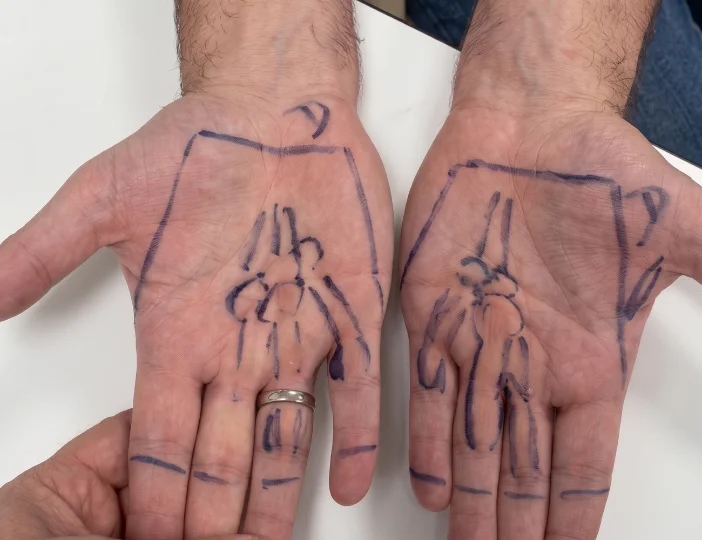
The gap between your fingers narrows as the tissue between them tightens, turning a wide U shape into a narrower V. You may notice it when spreading your hand out flat or reaching across a keyboard.
As the cords shorten, one or more fingers are gradually drawn in towards the palm and become harder to straighten fully. This is the stage known as a contracture, and it is the point at which treatment options change. Many people are surprised by how common Dupuytren's contracture is, particularly in later life.
Around one in five people with Dupuytren's in the hands develop similar firm lumps in the arch of the foot. This is called Ledderhose disease, and it can become tender when standing or walking.
Why Low-Dose Radiotherapy
Low-dose radiotherapy acts on the overactive cells that lay down the abnormal tissue, slowing the process that drives nodules and cords. The aim is to hold the hand as it is now. It is not expected to reverse a bend that has already formed.
Left untreated, around a third of people go on to need surgery for a contracture. Published evidence indicates radiotherapy reduces that risk by roughly three times. Outcomes vary, and no treatment can guarantee an individual result.
Treatment is delivered from outside the body, so there are no incisions, no needles, no anaesthetic and no splinting afterwards. The treatment itself is painless and most people feel nothing at all while treatment is delivered. You can read how surgery compares with radiotherapy if you are weighing up your options.
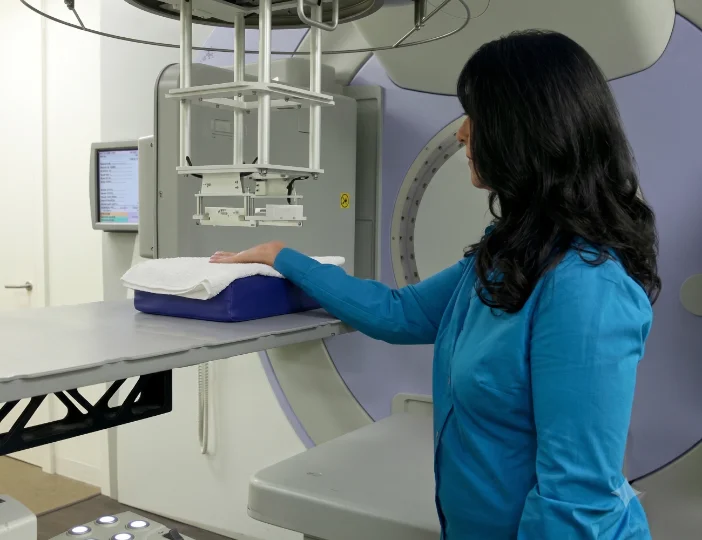
Each session takes around ten minutes per hand, in an appointment of roughly twenty minutes. You can drive yourself, go straight back to work, and carry on as normal the same day.

First Block
Over one week, Monday to Friday.
Break
Nothing to do. We are flexible on timing and can work around your commitments.
Second Block
Over one week, completing the course of ten.
Your Treatment Plan
Radiotherapy for Dupuytren’s is given in two short blocks rather than all at once, with a gap in between to give the tissue time to respond. Each session takes around ten minutes per hand, in an appointment of about twenty minutes. Your hand rests flat while the machine moves around you. You will not feel anything – there is no heat, no stinging and no drowsiness, and you can drive yourself to and from every appointment and go straight back to work. You can read more about how Dupuytren’s contracture is diagnosed, including the tests and imaging we may use. If you are thinking of booking a consultation, here is what to expect at your first appointment.
After Your Treatment
Two to three weeks after each treatment week, the skin on your palm may become red, sore or dry, similar to mild sunburn. This affects only the small area treated. A simple, unperfumed moisturiser is usually all that is needed, and for most people it settles within a couple of weeks. While the skin is sore it is more easily damaged, so take extra care with manual work during that time.
Around one in five people have lasting dryness in the treated area, because radiotherapy reduces the activity of the sweat glands there. This is managed with moisturiser. There is also a theoretical risk that radiation can cause a type of skin cancer in the treated area.
Radiotherapy is slow to take effect. Some people notice a difference within a few months, but it can take up to a year for the full benefit. A small number find things feel worse for a few weeks before they improve.
Is Radiotherapy Right for You?
The most important question is not what your hand looks like today, but whether it has been changing. Radiotherapy works best while the condition is active and before a fixed bend develops. Radiotherapy becomes less effective the further a bend has progressed, which is why timing matters more than severity. If your fingers are still straight but no longer bend back as far as they once did, that is often the point to be assessed rather than a reason to wait. Our consultants will measure each finger, compare it against any previous measurements, and tell you honestly which of these three situations applies to you.

Nodules that have stayed much the same over the past year, with your fingers still bending back normally. No treatment needed yet, but worth reviewing so that any change is picked up early.

The condition has progressed over the past year, or your fingers no longer bend back as far as they used to. This is the stage at which radiotherapy is most likely to help, and treatment can still be appropriate once a slight bend has started.

The finger no longer straightens and the hand does not work as you need it to. Radiotherapy cannot release a contracture that has already formed. Surgery or needle treatment can, and your consultant will refer you to a hand surgeon.
Care That Stands Apart
Ergéa Clinics is a consultant-led clinic specialising in low-dose radiotherapy for benign conditions. The same consultant looks after you from your first assessment through to follow-up. We see patients from across Manchester, Cheshire and the wider North West.

Often not, and many people who worry about this turn out to be treatable. Radiotherapy works best while the condition is active and before a finger has developed a fixed bend, and its effectiveness reduces as a bend becomes more established, but it can still be considered where a slight bend has started.
There is also such a thing as too early. If you have had a nodule or two for only a few months and nothing has changed, monitoring may be the right step. An assessment with one of our consultants, including proper measurements of your hand, will tell you which applies to you and what the right next step is.
Low-dose radiotherapy uses a far smaller dose than cancer treatment, targeted at a small area of the hand. The most common side effect is temporary. Two to three weeks after each treatment, the skin may become red, sore or dry, similar to mild sunburn, and this usually settles within a couple of weeks with a simple moisturiser. Around one in five people have lasting dryness in the treated area, because radiotherapy reduces the activity of the sweat glands there.
There is also a theoretical risk that radiation can cause a skin cancer in the treated area. To put that in context, the lifetime risk of skin cancer from ordinary sun exposure is roughly one in ten, and radiotherapy adds less than 0.1% to that. Your consultant will go through all of this with you before you decide anything.
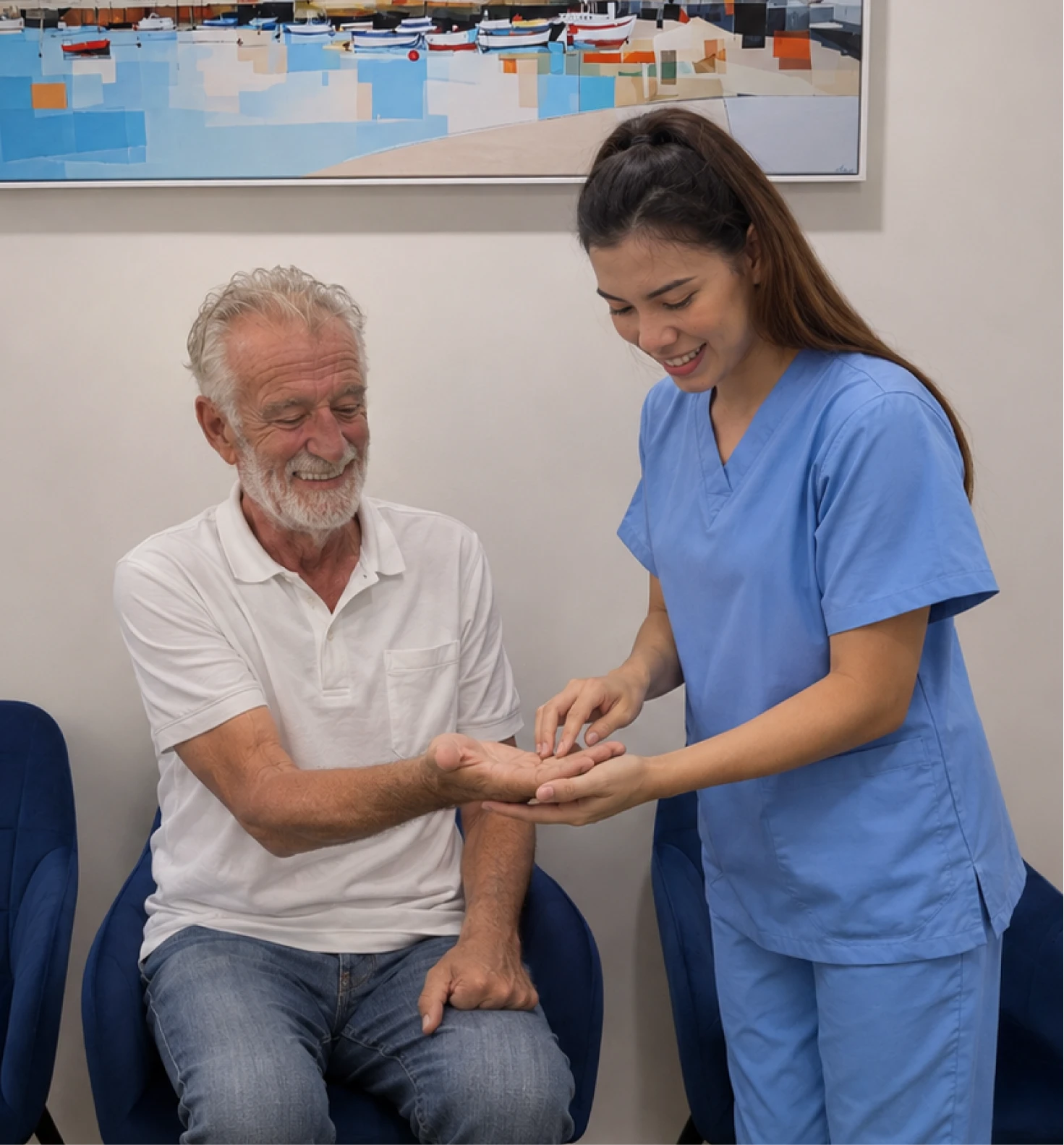
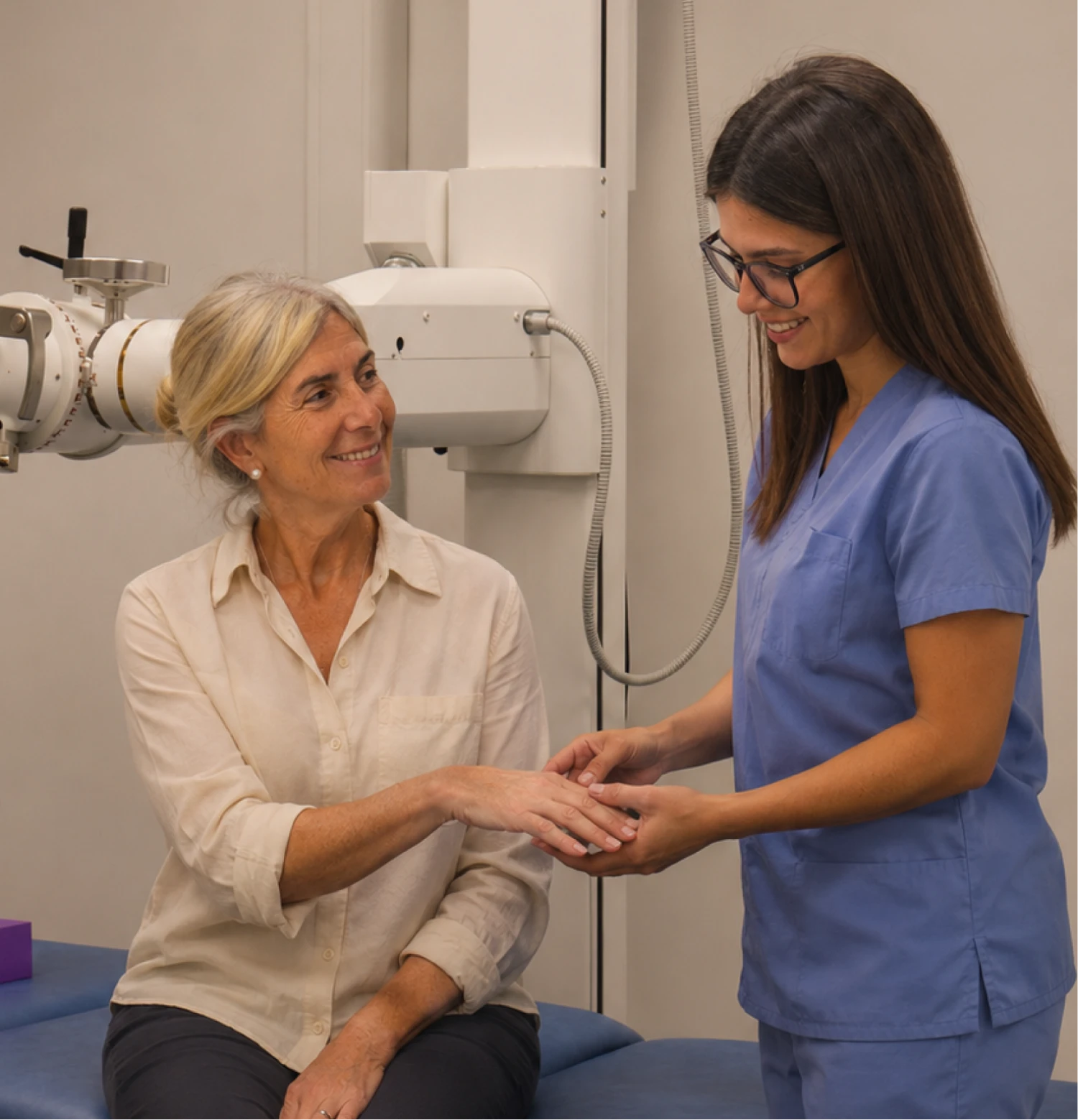
Your consultant will ask when you first noticed the changes, whether anyone in your family has had similar hand changes, and what you use your hands for day to day. They will then examine both hands, and usually your feet, measuring the extension of each finger, the span between them and the movement in your thumbs. Photographs are taken so that any change can be measured accurately at your next visit.
You will then discuss what the findings mean. Not everyone needs treatment straight away and, for some people, the right decision is to monitor and reassess.