Key takeaways
- Specialists typically diagnose Dupuytren's contracture through a hand examination and evaluation of your medical history, including your family history and any other health conditions.
- Hueston’s tabletop test checks whether a contracture has reached the point where surgery may be considered, but a specialist can assess you much earlier, when nodules or cords first appear.
- Imaging is not routinely used to diagnose Dupuytren’s contracture.
- Specialist assessment can help you understand how far your condition has progressed and which treatments remain suitable.
- Radiotherapy is an option before a contracture is established or while it is still mild, so getting an early, accurate diagnosis can keep more treatment paths open.
Dupuytren’s contracture is a condition that your specialist can generally diagnose by looking at and feeling your hand and asking a few questions. Lab tests and biopsies are generally not needed. Read on to learn what most assessments involve and what your specialist may ask.
Who diagnoses Dupuytren’s contracture and what to expect
Your doctor will typically follow a standard set of steps to examine your hand for Dupuytren’s contracture:
- Medical history evaluation: Discussing your symptoms, how quickly they’ve developed and your family and medical history.
- Physical examination: Visually inspecting your palm and fingers and feeling the tissue for nodules and cords.
- Finger Flexibility: Test how far back your fingers can bend and your finger span.
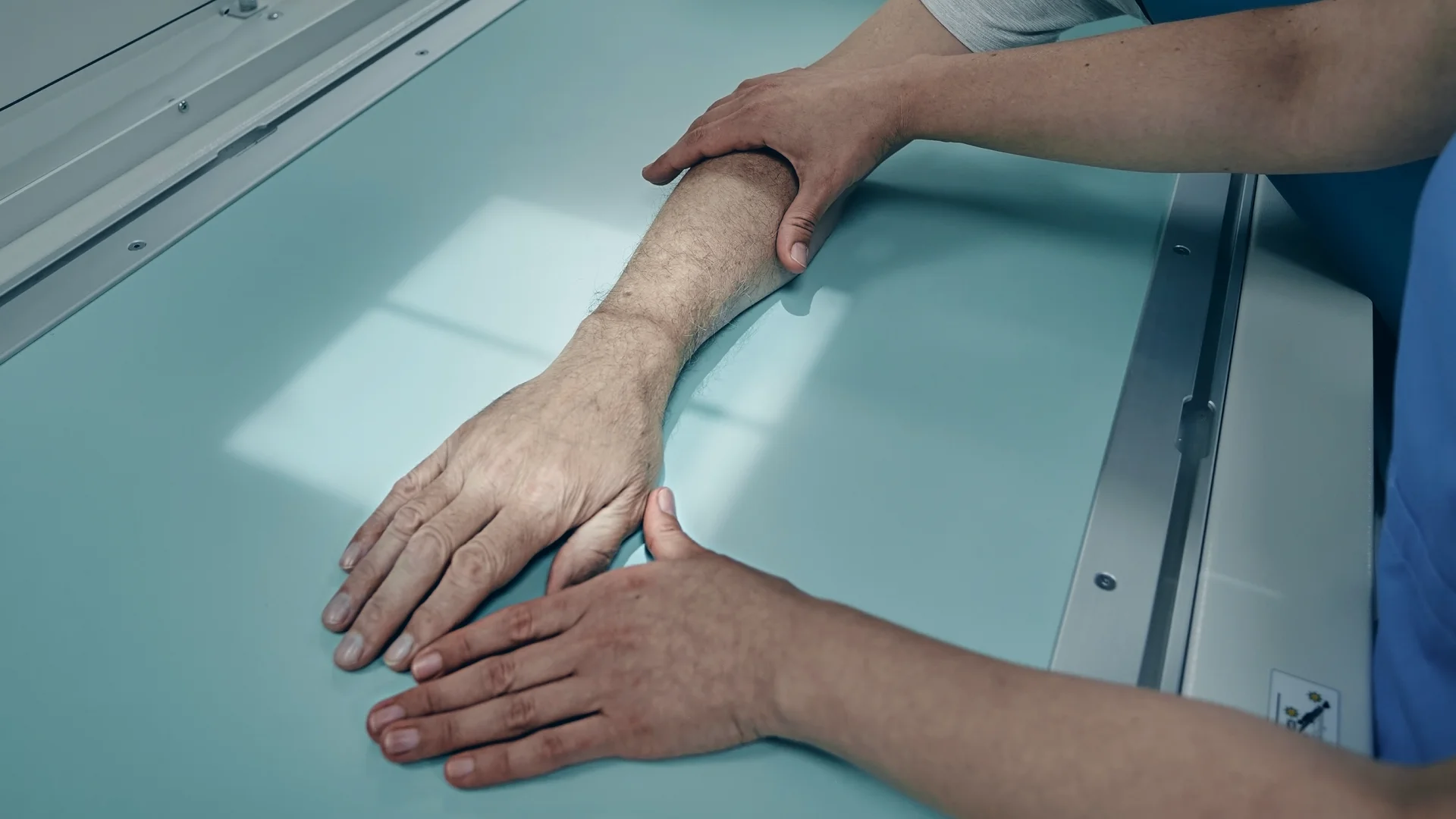
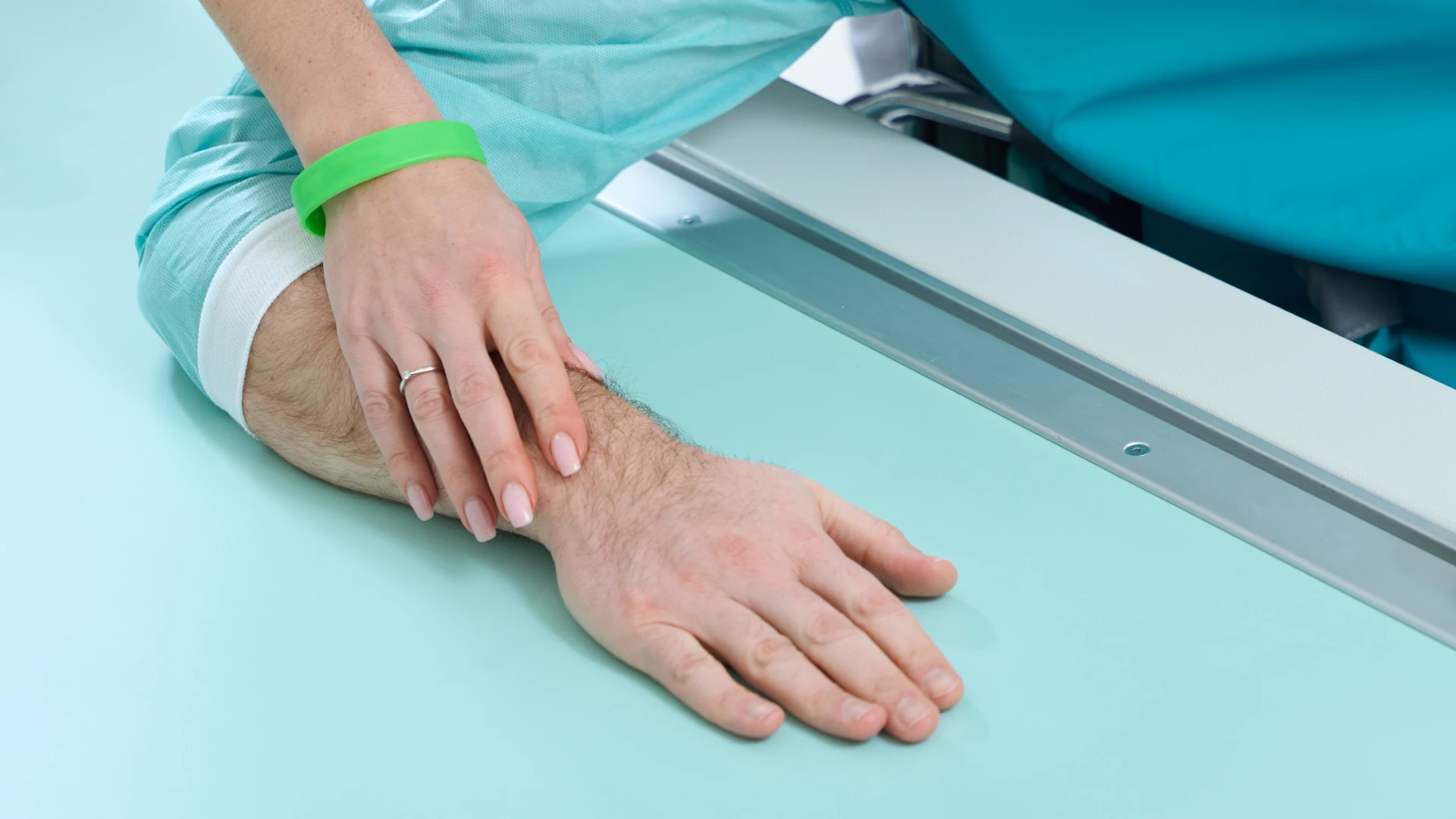
- Tabletop test: A simple movement test to see if your hand can lie flat on a surface.
If your doctor finds that your fingers are not fully straightening, they will usually measure your joint to see if it held at a fixed angle. This helps them understand how far the condition has progressed and decide which treatments may be suitable.
At Ergéa Clinics, a specialist can professionally assess your hand, evaluate your condition and advise you on your next steps in the same appointment, including whether radiotherapy may help.
Medical history: what a specialist asks, and why
Evaluating your medical history helps your specialist assess your underlying risk factors and how the condition may progress. During your assessment, they may ask whether any of the following apply to you:
- Family history of Dupuytren’s contracture: Genetics play an important role in Dupuytren’s contracture. Having a parent or close relative with the condition increases your risk. However, you may still have inherited the genes linked to Dupuytren’s even if nobody else in your family has the condition, because it does not necessarily appear in every generation.
- Diabetes: Studies have linked diabetes to the condition, although the exact relationship isn’t clear.
- Epilepsy: Both epilepsy and the long-term use of certain anti-seizure medications, like phenobarbitone, are linked to a higher risk of Dupuytren’s.
- Alcohol and smoking habits: High alcohol consumption and smoking may both be related to the disease.
What is the tabletop test for Dupuytren’s contracture?
Hueston’s tabletop test is a simple physical test used to judge whether a contracture has reached the point where surgical assessment is appropriate. It is not the test for radiotherapy, which can be considered earlier. It is also used by the NHS as the threshold for professional intervention, depending on your area. If one or more of your fingers remain bent or you can’t place your hand flat (a positive result), see your GP to be assessed for surgery. If you notice nodules or cords but your hand still lies flat, a specialist can assess whether radiotherapy may help. They can evaluate your condition and provide personalised advice on recommended next steps.
See a specialist if:
- You notice nodules or cords in your palm, even if your hand still lies flat.
- A finger stays bent in the tabletop test (see your GP about surgery) or you’re having difficulty with daily activities.
Staging: how severity gets measured
If your specialist detects a cord, they will measure how far it has pulled your finger out of line. They will use a small measuring device (a goniometer) to measure the angle of each affected joint. The knuckle (MCP joint) and middle joint (PIP joint) of the ring and little fingers are the most commonly affected.
Specialists often describe four broad phases for Dupuytren’s contracture:
- Nodules only: Tissue cells multiply and form small, firm lumps (nodules) in your palm
- Early cords: Nodules may thicken into a cord, but your finger still straightens.
- Tighter fingers or mild contracture: Your finger feels tight or bends by up to around 10 to 20 degrees. This is the stage where radiotherapy is usually used, and it can be considered earlier if nodules or cords are present.
- Established contracture: You can no longer fully extend your finger. Your specialist may recommend different treatment options depending on the exact angle at which your finger is bent.
When imaging is actually used
A qualified specialist can typically diagnose Dupuytren’s contracture without imaging scans like ultrasound, MRI or X-ray. If your provider does recommend a scan, it may be to screen for a different condition, like a cyst or arthritis. Some scans that are used during evaluation include:
- Ultrasound, to help tell a Dupuytren’s cord apart from a cyst or another soft tissue mass when a lump doesn’t feel typical
- X-ray, to check for arthritis before deciding on treatment. MRI is only occasionally used, usually when the diagnosis is unclear
Conditions mistaken for Dupuytren’s contracture
Other conditions can affect your wrists, hands, and joints to cause similar symptoms to Dupuytren’s contracture. Common examples include:
- Ganglion cysts: Soft, small benign lumps on your finger or wrist joints
- Calluses: Thickened, raised layers of skin on your palms
- Trigger finger: A finger or thumb that catches or becomes temporarily stuck in a bent position, but can be straightened, unlike the fixed bend of Dupuytren’s contracture
- Arthritis nodules: Knobbly lumps on the finger joints caused by osteoarthritis. With Dupuytren’s you can’t straighten your fingers, whereas with osteoarthritis you may struggle to make a fist
A specialist assessment is the most reliable way to rule out issues with similar symptoms and confirm what is affecting your hand.
Why early diagnosis matters for Dupuytren’s treatment
Your specialist can recommend different treatments based on how far your Dupuytren’s contracture has progressed. An early, accurate diagnosis usually means you have more potential options.
There is no cure for Dupuytren’s contracture, but treatment either aims to stop it getting worse or to release an established contracture. Radiotherapy is mainly preventative, while the other options treat a finger that is already bent. Professional options include:
- Radiotherapy: Targeted, low-energy radiation can slow the progress of Dupuytren’s before a contracture becomes established or while the joint is only mildly contracted (around 10 to 20 degrees). Studies show that the condition progressed in 62% of patients who did not have radiotherapy, compared with 20% of patients who did.
- Needle fasciotomy: For an established contracture, a needle is used to puncture, weaken and snap the cord.
- Fasciotomy: For an established contracture, surgery to cut or remove thickened tissue.
- Collagenase injection (Xiaflex): An enzyme injection that softens the cord in an established contracture. This is not currently available in the UK.
Your specialist can often confirm the stage of your condition and talk you through your treatment options in the same appointment. Discussing your needs and beliefs can help them recommend available options, including the potential downtime, procedures, and long-term outlook.
How to book a Dupuytren’s assessment in the UK
Getting a clear diagnosis can help you make more informed decisions about your hand. At Ergéa Clinics, you can get high-quality professional care from a consultant radiotherapy specialist.
Frequently asked questions
When should I see a specialist for Dupuytren’s contracture?
You do not need to wait for a positive tabletop test. If you notice nodules, cords or tightness in your palm or fingers, a specialist can assess whether radiotherapy could help while the condition is still mild. If your hand will not lie flat, see your GP to be assessed for surgery.
What is the tabletop test?
Hueston’s tabletop test is a quick physical check of whether a contracture is advanced enough to consider surgery. You rest your palm flat on a table or worktop. If one or more of your fingers cannot lie completely flat, it is a positive result, and you should see your GP to be assessed for surgery. A specialist can assess you for radiotherapy earlier, before the test is positive.
Do I need a scan to be diagnosed?
In most cases, no. A doctor can usually diagnose Dupuytren’s contracture simply by examining your hand and taking a brief medical history. Scans like ultrasounds or X-rays are not routine for this condition; they are usually only ordered if a specialist needs to rule out other issues, such as a ganglion cyst or arthritis.
Can Dupuytren's contracture be mistaken for something else?
Yes. Conditions like trigger finger (which causes a catching or locking sensation), ganglion cysts (soft lumps), or arthritis nodules can mimic early symptoms. A physical examination by a specialist is the best way to rule these out and ensure you get the correct diagnosis.
Does early diagnosis affect treatment options?
Yes. Diagnosing Dupuytren’s contracture early keeps more treatment paths open to you. For example, radiotherapy is most useful before your finger joint becomes permanently fixed at an angle. Once a severe contracture is established, your options may be limited to surgical or needle-based options instead.
Will I need a biopsy to confirm Dupuytren's contracture?
A biopsy is generally not needed to diagnose Dupuytren’s contracture. A specialist can often diagnose the condition simply by examining your hand.
Does Dupuytren's Contracture Run in Families?
Yes. Genetics play an important role in Dupuytren’s contracture, and having a parent or close relative with the condition increases your risk. However, you can still inherit the genes linked to Dupuytren’s even if nobody else in your family has the condition, because it does not necessarily appear in every generation. Having a family history also does not mean you will definitely develop the condition.
What will my specialist ask me?
Your specialist will want to know how your hand symptoms have developed over time and how they impact your daily life. To assess your risk factors, they will also ask about your family history, lifestyle (such as smoking or alcohol use), how you use your hands from day to day, and underlying conditions like diabetes.